
Last updated September 10, 2026
Full 25-point door and opener safety check with every visit - springs, cables, rollers, tracks, and your LiftMaster or Chamberlain opener included
You get a price before we start. It does not change when the truck arrives.
 Before
 After
After Before
 After
After Before
 After
AfterSeasonal Garage Door Care for Chula Vista: Year-Round Homeowner’s Guide
Chula Vista homeowners sometimes skip fall garage door maintenance because “it doesn’t really get cold here.” That’s the wrong frame. Fall in Chula Vista is Santa Ana season - low humidity, high wind, and airborne grit that shreds weatherstripping and jams tracks faster than any frost cycle. After 42 years of working on doors from Otay Ranch to Terra Nova, we’ve learned that the coastal-south climate creates four distinct maintenance windows, each with its own threat pattern. This guide maps what to do and when to do it, tied to the actual conditions your door faces.
Quick Answer
Seasonal garage door care in Chula Vista follows four local weather windows rather than a traditional four-season calendar: winter rain intrusion (Dec-Feb), spring rust bloom (Mar-May), summer UV and heat stress (Jun-Aug), and fall Santa Ana wind prep (Sep-Nov). A homeowner can handle basic inspection and cleaning year-round with a step stool and flashlight, but spring tension adjustments and cable work should always involve a trained technician - a question we explore in our DIY vs Professional Garage Door: The Chula Vista Homeowner’s Decision Guide.
Table of Contents
- Winter: Rain-Season Threshold and Bottom-Seal Defense
- Spring: Post-Rain Hardware Check for Rust Bloom
- Summer: UV, Heat, and Opener Motor Stress
- Fall: Santa Ana Wind Prep and Grit Removal
- The One-Hour Seasonal Walkthrough You Can Do Yourself
- Common Mistakes to Avoid
- When to Call a Professional
- Frequently Asked Questions
Winter: Rain-Season Threshold and Bottom-Seal Defense
December through February brings the bulk of Chula Vista’s annual rainfall - roughly 10 to 12 inches concentrated in brief, intense bands. For garage doors, the critical failure point is the threshold where the bottom seal meets the driveway. In newer tracts throughout Otay Ranch, Eastlake, and Rolling Hills Ranch, flat-grade concrete driveways were poured with minimal slope toward the street. Water pools at the door line, tests the seal, and seeps inward.
We’ve replaced bottom seals in Chula Vista homes where the rubber had hardened to plastic after three winters of UV-plus-moisture cycling. Once rigid, the seal can’t conform to minor concrete imperfections. The gap may be only a sixteenth of an inch, but that’s enough to let water migrate across the slab and wick into stored boxes, drywall corners, and the bottom plates of framed walls.
What to inspect in winter:
- Run a garden hose at the driveway seam during dry weather and check inside for dampness after ten minutes.
- Look for cracks, flattening, or permanent compression set in the bottom seal - it should rebound when pressed.
- Clear drainage paths: leaves from sycamore and ficus trees common in Chula Vista neighborhoods clog the narrow gaps between driveway and planter beds.
- Check the weatherstripping on the door jambs; winter rain in Chula Vista often arrives horizontally during Pacific storms, driving water around the sides if the seal is gapped.
If the seal is older than five years and shows UV checking - fine surface cracking like dried leather - replacement is the only fix. We carry universal and brand-specific bottom seals on our trucks, including profiles for Clopay, Amarr, and Wayne Dalton doors common in local tract builds. Most winter seal replacements in Chula Vista are completed in a single visit.
One detail homeowners miss: the aluminum retainer track that holds the seal. In coastal-adjacent Chula Vista, salt air from the bay accelerates corrosion in these thin-gauge channels. A seal won’t seat properly in a pitted retainer. We inspect the retainer as part of every seal replacement and quote the full repair before starting work.
Spring: Post-Rain Hardware Check for Rust Bloom
March through May in Chula Vista is the transition window - marine layer mornings, occasional late storms, and rising temperatures that push humidity into the garage as the slab warms. This combination produces rust bloom on hardware faster than the dry summer months that follow.
The hardware at risk includes:
- Torsion springs and their stationary and winding cones
- Hinges, particularly the center hinges that carry the most load
- Top and bottom fixtures where cables attach
- Track mounting brackets and lag screws
- Roller stems in older steel rollers
In our experience across Chula Vista, from the older homes in Castle Park to the newer builds in Rancho del Rey, rust bloom appears first on the bottom fixtures and lower hinges. These sit closest to the slab where moisture lingers longest. A light surface discoloration is cosmetic. Orange flaking that exposes fresh metal beneath is not - it indicates active corrosion that thins the metal.
Spring inspection priority: the spring system.
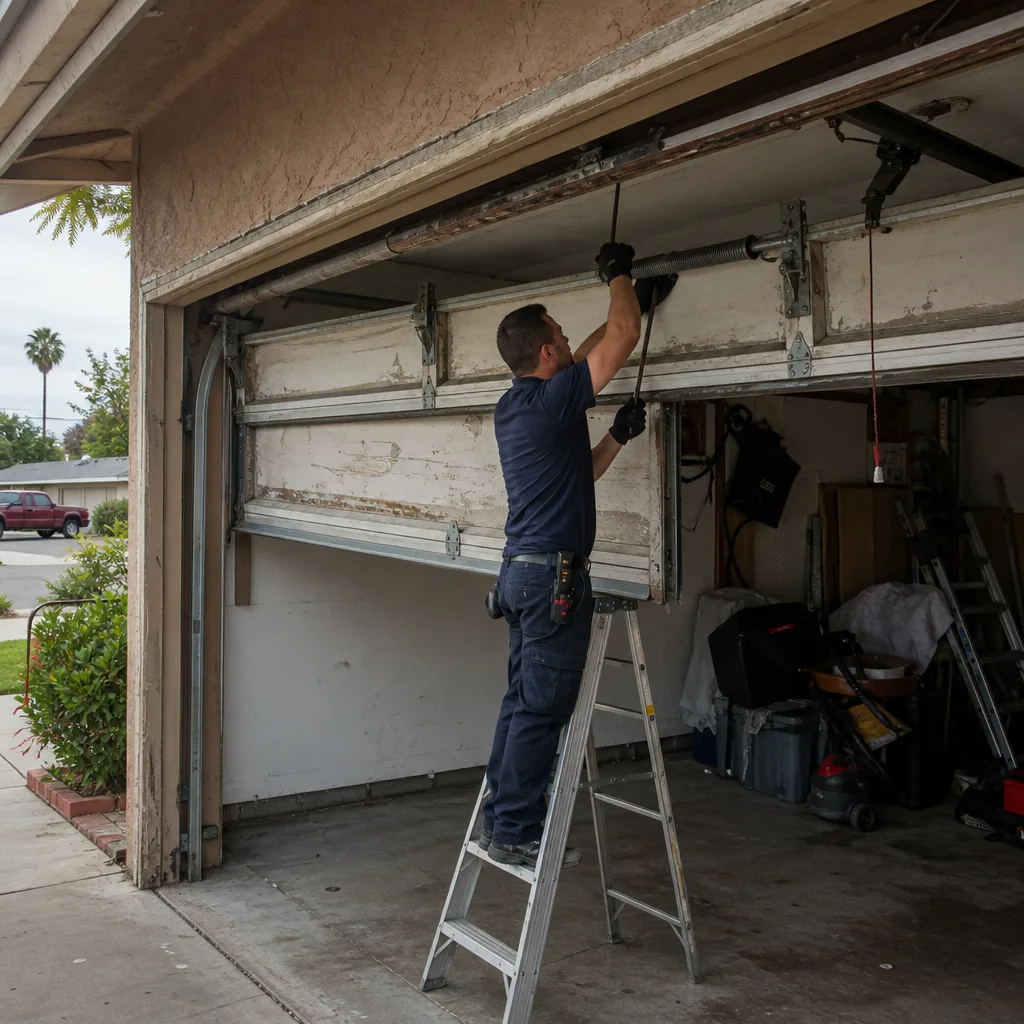
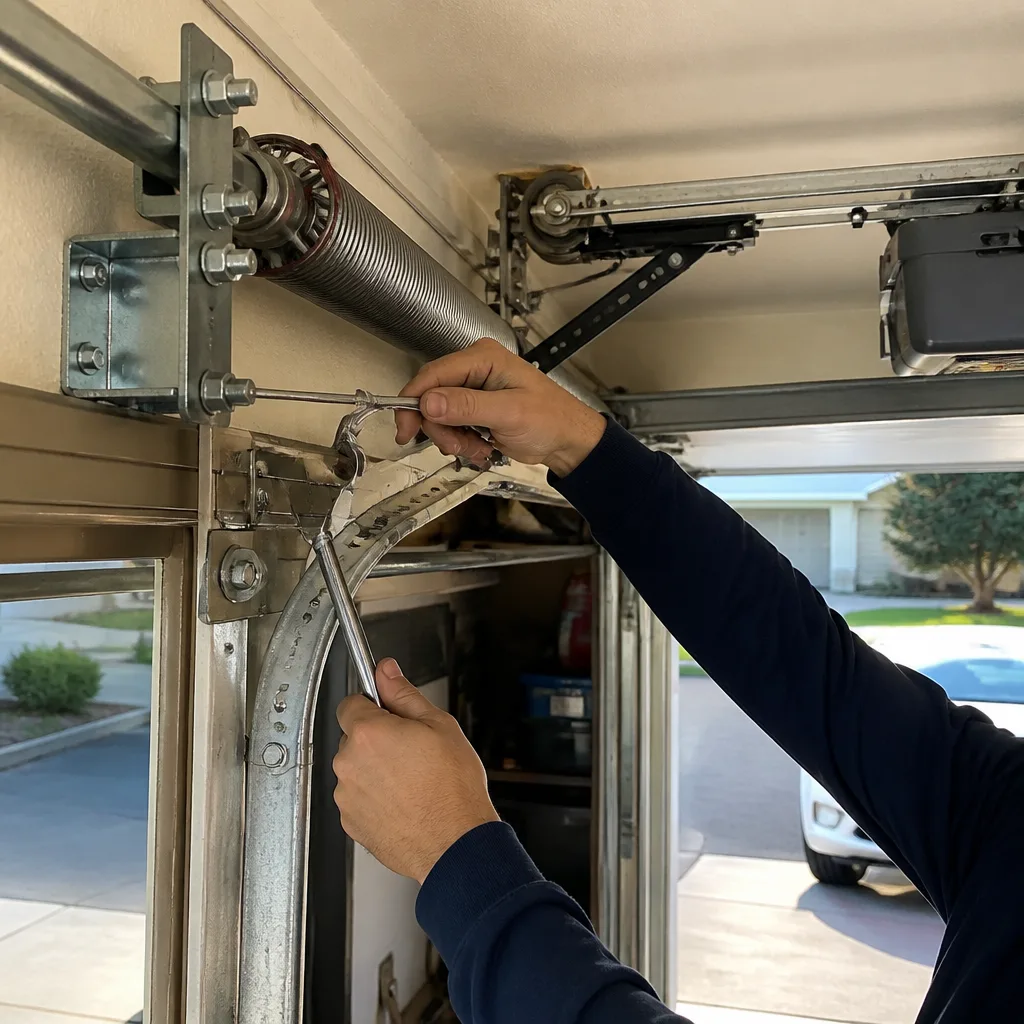
Torsion springs are under extreme tension and store enough energy to cause serious injury or death if mishandled. Do not attempt to touch, lubricate, or adjust them. What you can do: stand inside the garage with the door closed, use a flashlight, and look for:
- Gaps between coils in the wound spring - a sign of settling or fatigue
- Rust scale that flakes when lightly brushed with a gloved fingertip
- Shiny spots on the spring wire where the factory coating has worn through
- Any separation between the spring and the cone - this is a failure in progress
If you observe any of these conditions, stop using the door and call for service. A failed torsion spring can drop a door suddenly or damage the opener. We replace springs in Chula Vista with galvanized or oil-tempered wire rated for the coastal environment, and we always replace both springs on a dual-spring system even if only one has failed. The unmatched cycle life of a single new spring beside an old one guarantees a second service call within months.
Spring is also the right season to test door balance. Disconnect the opener per manufacturer instructions and lift the door manually to waist height. It should stay put, neither rising nor falling. In Chula Vista’s spring humidity, swollen wooden doors or rust-affected hardware can shift balance enough to strain the opener motor. If the door drifts, the spring tension needs adjustment - a task for trained technicians with winding bars and proper anchoring knowledge.
Summer: UV, Heat, and Opener Motor Stress
June through August brings Chula Vista’s most intense UV exposure and the highest garage temperatures of the year. South- and west-facing doors in neighborhoods like Sunbow and Terra Nova see surface temperatures exceeding 140°F on the exterior skin. The effects are cumulative and often invisible until failure.
Panel finish degradation. Steel doors with factory-baked polyester or silicone-modified polyester finishes hold up well, but once the topcoat chalks or cracks, UV penetrates to the primer and bare metal. Fiberglass doors, popular in 1990s Chula Vista tract builds, are particularly vulnerable - the gel coat oxidizes, turns chalky, and the underlying resin becomes brittle. We’ve replaced fiberglass panels that shattered from minor impact after UV degradation weakened the substrate.
Inspect your door’s finish in summer by running a clean white cloth across the surface. Significant chalking - a white residue on the cloth - means the UV barrier is thinning. For steel doors, a quality automotive-grade wax buys time. For fiberglass, the window for restoration is narrow; once the gel coat is compromised, panel replacement is the durable fix.
Torsion spring tension drift. Steel springs expand slightly in sustained heat. The effect on a properly engineered system is negligible. But in Chula Vista’s summer, garages with poor ventilation or dark roofs can reach 110°F ambient, and the spring operates at the edge of its design envelope. Combined with a door that’s already marginally heavy from age or hardware drag, the opener works harder, trips thermal overloads, or fails entirely.
We see this pattern every July and August: a LiftMaster or Chamberlain opener that ran fine in spring begins stopping mid-travel or flashing error codes. The motor isn’t failing - it’s protecting itself from overheating while trying to move a door that’s out of spec. The real fix is spring tension adjustment and hardware service, not opener replacement.
Opener motor ventilation. Summer is when opener location matters. Units mounted against uninsulated garage ceilings or in corners with no air circulation run hottest. Check that the motor housing vents aren’t blocked by dust or spider webs. If your opener has a battery backup (required on new installations in California since 2019), the battery compartment is especially heat-sensitive. High garage temperatures reduce battery life and can trigger false low-battery alerts on Raynor, Genie, and LiftMaster systems.
Our $89 Seasonal Tune-Up includes thermal testing of the opener motor under load, spring tension verification, and hardware torque-checking - work that prevents the midsummer failure pattern we see repeat every year in Chula Vista. For a fuller picture of pricing factors, see our Garage Door Cost Breakdown: The Chula Vista Homeowner’s Reference for 2026.
Fall: Santa Ana Wind Prep and Grit Removal
September through November is the most misunderstood maintenance window in Chula Vista. Temperatures stay mild. Rain is rare. Homeowners assume the door can coast. In reality, this is the highest-stress season for garage door systems in our region.
The Santa Ana wind cycle brings sustained easterly winds of 25 to 45 mph, with gusts exceeding 60 mph in exposed areas of Chula Vista’s eastern ridges. These winds are dry, carrying fine dust from the desert and coarse grit from construction sites and unpaved areas. The combination loads the door panel as a sail, stresses the track alignment, and introduces abrasive contamination into every moving joint.
We’ve responded to emergency calls in Chula Vista after Santa Ana events where the wind load alone had bowed a door section off its track, or where grit accumulation had seized rollers so completely that the opener stripped its drive gear trying to move the door. Both are preventable with focused fall prep.
Fall maintenance tasks:
- Track cleaning. Wipe the interior of both vertical and horizontal tracks with a damp rag to remove summer dust buildup. Do not lubricate the track - lubricant attracts grit and creates a grinding paste. The track should be clean and dry.
- Roller inspection. Nylon rollers should roll freely and silently. Steel rollers should show no flat spots or bearing roughness. If rollers bind or wobble, replace them before wind loading amplifies the stress.
- Weatherstrip flexibility check. After summer UV exposure, vinyl and rubber seals harden. Flex the bottom seal and jamb seals - they should bend without cracking. Santa Ana winds force air through any gap; a rigid seal that no longer compresses is a leak point.
- Balance test. With the opener disconnected, the door should stay at any position between fully open and fully closed. A heavy door is a liability in wind; the opener clutch or force settings may not protect against a sudden gust-assisted descent.
- Hardware torque verification. The vibration of a door operating against wind-loaded panels loosens track bolts and jamb brackets. Check visible fasteners for tightness; do not over-torque lag screws into dry wood.
In Chula Vista neighborhoods near the Otay Mesa border - where Santa Ana winds accelerate across open terrain - we recommend inspecting door-to-track clearance after the first major wind event of fall. A door that rubs the track face under load is misaligned and will wear the track edge or the door skin.
Fall is also the season to verify your opener’s force settings. After a full summer of operation, the motor’s learned force curve may not match current door resistance. A properly adjusted opener reverses on a 2×4 test board placed flat on the threshold; if it doesn’t, the down-force is excessive and dangerous. We test and calibrate force settings as part of every seasonal service call.
The One-Hour Seasonal Walkthrough You Can Do Yourself
Most Chula Vista homeowners can complete a thorough seasonal inspection in under an hour with no special tools. This routine covers the critical checkpoints for all four maintenance windows and flags problems before they become emergency calls.
What you’ll need: a sturdy step stool, a flashlight, a clean rag, a garden hose, and a 2×4 scrap board.
- Visual sweep (10 minutes). With the door closed, inspect the full exterior face for finish damage, dents, or panel separation. Check the bottom seal for compression set, cracking, or gaps against the driveway. Open the door and inspect the interior face, paying attention to the bottom section where road splash and moisture collect.
- Hardware and spring inspection (15 minutes). From inside with the door closed, examine the torsion spring, spring anchor bracket, and cable drums with a flashlight. Look for rust, gaps between coils, or cable fraying. Do not touch the spring. Move to the hinges and rollers - each hinge should be intact with no cracks, each roller should sit properly in the track with no wobble.
- Track and roller function (10 minutes). With the door open, wipe the track interior clean and dry. Operate the door manually by disengaging the opener (pull the red release cord with the door closed). The door should move smoothly through the full travel with no binding, grinding, or points of resistance.
- Balance test (5 minutes). With the opener disengaged, raise the door to waist height and release. It should remain stationary. If it rises or falls, note the direction and distance - this information helps us diagnose spring condition when you call.
- Auto-reverse and force test (10 minutes). Re-engage the opener. Place the 2×4 flat on the threshold centered under the door. Close the door with the remote. It should reverse on contact with the board. If it doesn’t, stop using the opener and call for service - this is a safety-critical failure.
- Threshold water test (10 minutes, winter priority). With the door closed, run the garden hose at the driveway seam for five minutes. Check inside for any dampness or water intrusion. Note the location of any leak for discussion with your technician.
Document what you find. Photos of specific concerns help us prepare the right parts before dispatch. Most garage door repair in Chula Vista that we perform follows a homeowner inspection that identified the problem early - the difference is often a scheduled tune-up versus an after-hours emergency with a door stuck open.
Common Mistakes to Avoid
- Using WD-40 on tracks or rollers. WD-40 is a solvent and light penetrant, not a lubricant. On garage door components, it strips existing grease, attracts dust, and creates a binding film. Use a silicone-based spray or lithium grease on hinges and rollers only; tracks stay clean and dry.
- Ignoring the manual release cord. Many Chula Vista homeowners have never disengaged their opener. During a power outage or opener failure, fumbling with the release mechanism while the door is partially open is dangerous. Practice the release and re-engagement during daylight, with the door fully closed.
- Adjusting spring tension or cable attachment. Torsion springs store lethal energy. Winding cone set screws, cable drums, and bottom fixtures are not user-serviceable. We’ve seen serious injuries from homeowners who followed online tutorials. This work requires proper tools, training, and physical anchoring.
- Delaying seal replacement until water damage appears. By the time drywall stains or stored item damage is visible, the seal has been failing for multiple seasons. In Chula Vista’s flat-grade developments, the threshold is the most vulnerable point - inspect it proactively.
- Assuming all openers need replacement when they malfunction. In summer especially, opener strain is often a symptom of door imbalance or hardware drag. Replacing a functional opener without addressing the underlying mechanical issue wastes money and repeats the failure pattern.
- Skipping fall maintenance because “the weather is nice.” Santa Ana winds are the highest mechanical stress your door faces annually. The mild temperatures are deceptive - the wind load is real.
When to Call a Professional
Call for service when you observe spring coil gaps, cable fraying, opener force-test failures, or any door that won’t stay balanced manually. These conditions indicate systems that can fail suddenly and cause injury or property damage. We also recommend professional service when your inspection reveals water intrusion at the threshold, significant rust on hardware, or panel damage that compromises door integrity.
Mainspring Garage Door Co. offers free estimates in Chula Vista - call (619) 901-2874. Our technicians arrive with springs, cables, openers, and seals on the truck, and we state the flat price before any work begins. Most jobs are completed in a single visit, backed by our 90-Day Done Right Promise in writing.
Frequently Asked Questions
A full seasonal inspection four times per year aligns with our local climate windows, but at minimum, perform the one-hour walkthrough twice yearly - before Santa Ana season in September and after the winter rain period in March. Call (619) 901-2874 to schedule our $89 Seasonal Tune-Up if you prefer professional inspection.
No. Torsion springs are under extreme tension and can cause serious injury or death if mishandled. Lubrication requires proximity to the wound spring and contact with moving components that are not user-safe. Our technicians apply the correct lubricant during service calls as part of standard maintenance.
Chula Vista garage temperatures often exceed 100°F in summer, and openers in poorly ventilated spaces overheat while trying to move doors that have drifted out of balance. The motor’s thermal protection shuts it down before damage occurs. The root cause is usually spring tension or hardware condition, not opener failure.
Our Seasonal Tune-Up is $89 and includes spring tension verification, hardware torque check, opener force calibration, roller and hinge lubrication, safety sensor alignment, and bottom seal inspection. Repairs identified during tune-up are quoted upfront with no obligation. Seniors and veterans receive a permanent 5% discount.
Yes. Torsion springs are installed as matched pairs with identical cycle ratings. Replacing one spring guarantees uneven lift, premature wear on the new spring, and likely failure of the old spring within months. We replace both springs on every dual-spring system, with the price quoted before work begins.
Disengage the opener and do not operate the door. Wind-loaded doors can have hidden track misalignment or panel stress fractures that make sudden failure likely. We provide 24/7 emergency response in Chula Vista for wind damage - call (619) 901-2874 and a live person will answer, including nights and holidays.
The Bottom Line
Chula Vista’s garage doors face four distinct stress cycles: winter rain at the threshold, spring humidity and rust, summer UV and heat, and fall Santa Ana wind loading. A homeowner who matches maintenance to these actual conditions prevents the failures that drive emergency calls. The one-hour seasonal walkthrough catches most problems early. For spring work, opener calibration, and conditions beyond your comfort, professional service is the safe choice. You’ll find expanded seasonal detail in The Complete Guide to Garage Door in Chula Vista. We’ve served Chula Vista since 2016, and we stand behind every job with a written 90-Day Done Right Promise.
Written by Carl Dutton, Owner at Mainspring Garage Door Co., serving Chula Vista since 2016. Browse more guides & resources from our team.